Aug 10, 2025
3 min read
How Life’s Oldest Code Mirrors the Systems We’re Building Today
When people hear the word blockchain, they picture Bitcoin wallets, Ethereum smart contracts, or digital ledgers spread across thousands of computers.
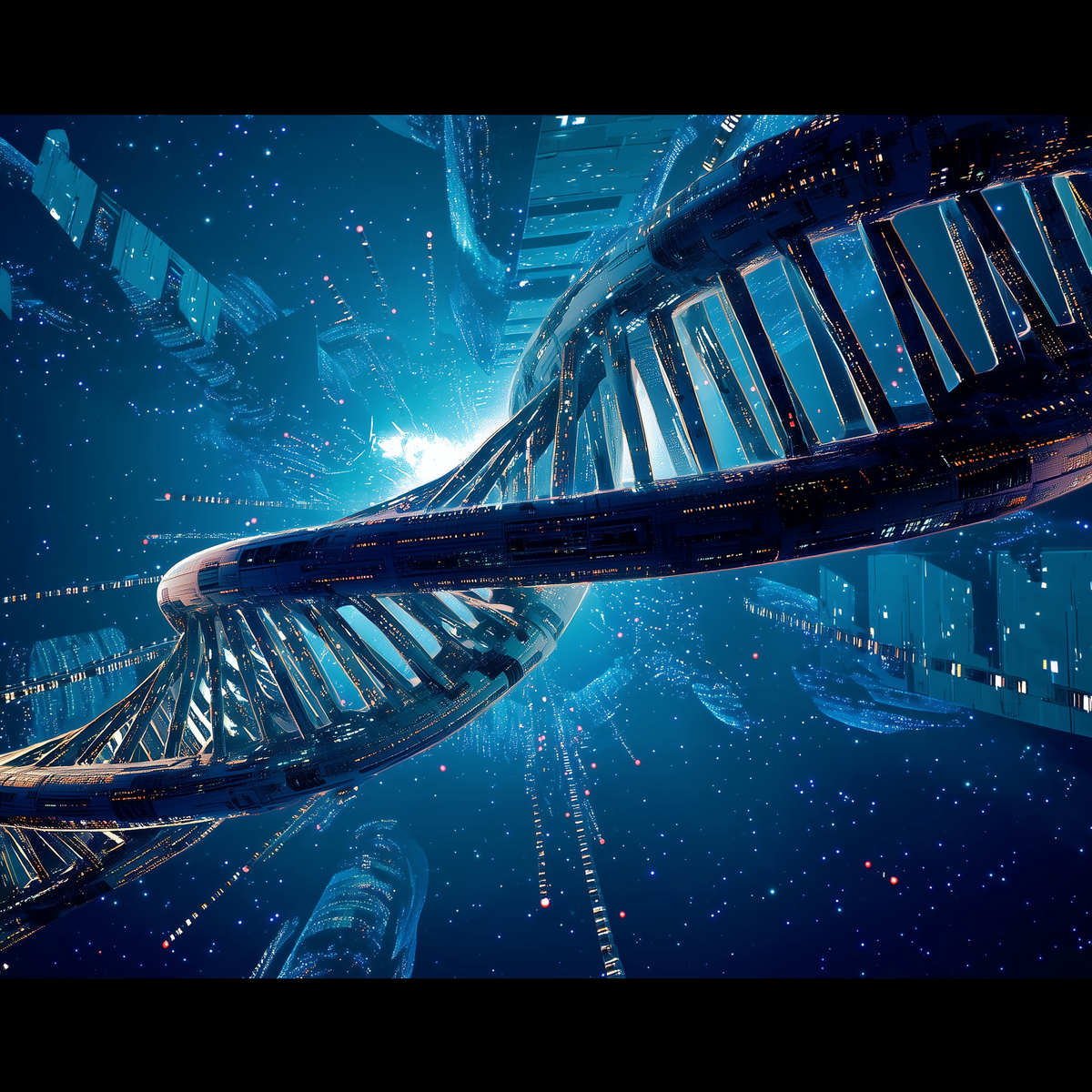
When people hear DNA, they imagine the double helix — the elegant spiral containing life’s blueprint.
But look closer and you’ll see something uncanny: both are distributed, self-validating, tamper-resistant systems. In many ways, DNA is the original blockchain — one that has been running flawlessly for billions of years.
If we want to design technology for the next hundred years, we should be studying the one network that has already survived eons.
A Ledger Written in Life
A blockchain is an append-only ledger. Once data is recorded and confirmed, it’s permanent.
DNA works the same way. Every mutation, recombination, or insertion is written into the record. Once those changes spread through enough cells — or into the next generation — they’re nearly impossible to reverse.
In blockchain, altering the ledger requires massive computational power and network consensus. In biology, rewriting DNA at scale means overcoming deeply embedded molecular safeguards. Both systems are built for permanence.
Every Node Holds the Whole
Blockchains are resilient because every node in the network carries the full record. Lose a few nodes, and the ledger still survives.
Your body works exactly the same way. Nearly every cell carries the complete genome. Each one is a self-contained copy of life’s instructions, ready to replicate, repair, and validate itself.
The enzymes that duplicate DNA act like blockchain synchronization protocols — ensuring each new “node” gets a perfect copy.
Consensus Keeps the Record True
On the blockchain, nodes validate transactions according to strict rules. In cells, DNA replication comes with an equally strict validation process: proofreading, mismatch repair, and error correction.
If something doesn’t match the “protocol,” the system halts or fixes the error. This consensus mechanism has kept life’s ledger astonishingly accurate for billions of years.
Privacy and Security Built-In
Blockchains use cryptography to protect data from tampering or theft. DNA’s equivalent is its physical and chemical protection: nuclear membranes, histone wrapping, and controlled access to genetic code.
In both cases, security isn’t optional — it’s fundamental. A corrupted ledger in tech means lost data. In biology, it means the collapse of the organism.
Smart Contracts and Gene Expression
Smart contracts on blockchain execute automatically when conditions are met. Genes do the same.
Regulatory sequences decide when a gene is “turned on.” Environmental signals or cellular triggers activate it. The result is protein — the tangible “output” of life’s code.
It’s programmable biology — and we’re only just starting to understand how deep that programming goes.
Forks and Evolution
In blockchain, a fork creates a new branch of history. In life, a fork is called speciation — when two populations split and evolve separately.
Each new branch writes its own version of the ledger, shaped by unique conditions and chance events. This is evolution as a multi-chain network.
Why This Matters for the Future
The parallels between DNA and blockchain aren’t just a curiosity — they’re a roadmap.
Nature has already solved the problems we’re facing in technology:
- How to store data for billions of years
- How to secure it from corruption
- How to distribute it without central control
- How to adapt while maintaining integrity
When we mirror these patterns, we tap into designs proven by deep time.
The Lesson from Nature’s Ledger
Blockchain may shape the digital future. But DNA is the original blockchain — a secure, distributed, self-healing ledger that has been running since the dawn of life.
If we have the humility to follow nature’s lead, we can build systems that are not only efficient and secure but also enduring.
At Tobiko, this is our compass — designing technologies that reflect the resilience, privacy, and adaptability that nature has already mastered. In a century, the systems we build should still be running — not as relics, but as living networks, evolving alongside us. We know which side we want to be on.