Aug 31, 2025
3 min read
How many ways are there to paint a rose?
You face a blank page, and already there are endless choices. Do you pick up a brush, a pencil, or a piece of chalk? Do you paint in red, pink, white, or black? Do you aim for realism, or let the rose dissolve into abstraction? Every decision branches into more decisions, and before you’ve made a single mark, you’re standing before a forest of possible roses.
Now imagine another artist beside you. Their roses bloom differently — darker palette, lighter hand, sharper lines, looser form. They, too, have a vast tree of possibilities.
But something astonishing happens when we imagine the roses between you.
What if we could blend your talents together? Ninety percent of your hand, ten percent of theirs. Then eighty-twenty. Then seventy-thirty. Each shift reveals a new rose: one stroke of yours mixed with one shade of theirs, your structure softened by their improvisation, their palette spilling into your precision.
Add a third artist, and suddenly we’re no longer sliding on a line but moving across a plane, drifting through infinite combinations. Add a fourth, and it becomes a cube. Add a fifth, and the space stretches beyond dimensions we can picture. Each new artist multiplies not just the number of roses, but the number of ways we can move between roses.
The roses don’t just sit side by side; they flow, blend, and transform, fluidly shifting from one into another, each hybrid opening the door to countless more.
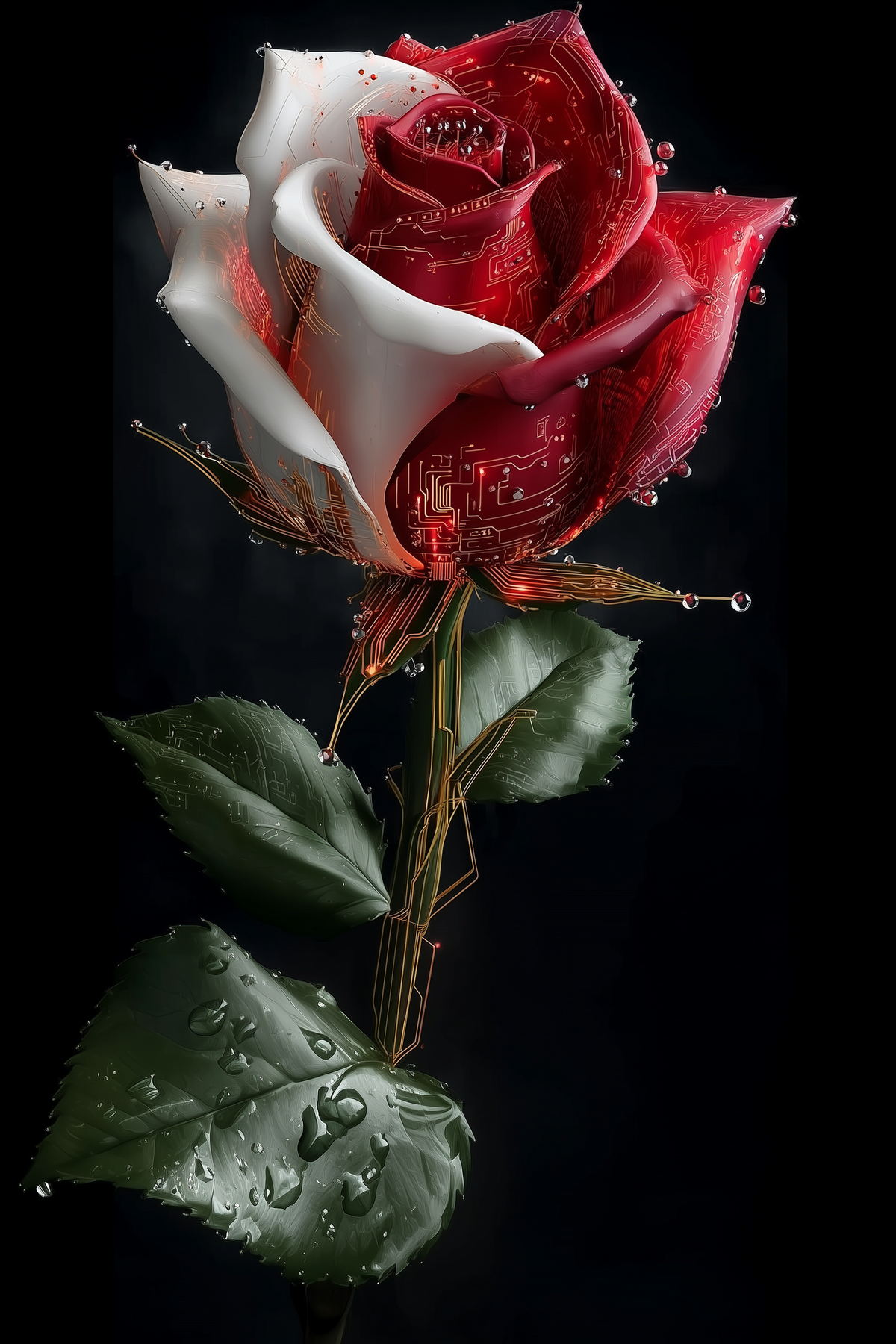
"This is the Infinite Rose: not the handful of roses that exist, but the unbounded garden of roses that could exist.
From nothingness to creation, from noise to signal.
What signal do we wish to form?
And yet, despite this vastness, each artist still paints only one rose. A single choice is made, one canvas committed, one path collapsed into being.
This is the paradox of creation: infinite possibility at the start, singular reality at the end. Every brushstroke is a narrowing, every decision a closing off of countless other paths. Out of the infinite rose, you summon only one.
But that infinite garden doesn’t vanish. It remains all around us — the space of everything that could have been.
In the language of AI, that space is called latent space. It is the field of all possible roses, all possible images, all possible outcomes. Our world contains only the roses actually painted. Latent space contains every rose that could be painted — even the ones no one has ever imagined.
Generative AI doesn’t pull images from a library or copy past works. Instead, it navigates this latent space — sliding between styles, blending influences, moving through the matrix of probabilities until a single image resolves.
At its beginning, AI starts with nothing but noise — static, randomness, chaos. Then, step by step, it filters that noise, shaping it, coaxing it into form. Out of the infinite rose, one is chosen. Out of pure probability, signal emerges.
Latent space is vast, but right now, we only have a small window into it. 🪟
A window into the matrix.
A door into the holodeck.
Through this window, we glimpse a place where the reality of any possible possible becomes real. A space where imagination and mathematics intertwine, and where even noise itself can give birth to form.
Think of the white noise on an old television set 📺 — static, meaningless, random. Yet within that storm of randomness, anything could take shape. A rose, a face, a memory, a world.
This is where the greatest discovery of generative AI came from: the act of removing noise. Scientists learned that by teaching machines how to strip away what seemed like randomness, they could build from noise upward — sculpting signal from static, form from chaos.
At the deepest level of physics, the same mystery exists. Quantum foam — the ultimate noise, the seething uncertainty beneath reality itself. If our universe is signal pulled from that foam, then the question becomes:
What signal do we wish to form?
We are the observers.
We are the painters.
We are the NOISE.
The Infinite Rose is no longer just an assignment in a classroom, nor just a metaphor for AI. It is a mirror for our species.
We now have a new painting to make.
And it is up to us to decide what it will be.
Will we choose beauty? Harmony? Understanding?
Will we make it a rose worth beholding? 🌹
The infinite garden is already here.
The canvas is open.
The brush is in our hands.