Oct 12, 2025
7 min read
The wall screen blinked on at six sharp, the voice cheerful and practiced — synthetic warmth wrapped around perfect diction.
“Good morning, citizens! Today marks a historic milestone in our nation’s journey toward complete automation. As of midnight, human operation of motor vehicles is officially prohibited under the Global Mobility Accord. Analysts predict a forty-eight-thousand–life annual reduction in traffic fatalities and a two-trillion-dollar improvement in efficiency.
Experts agree: this transition closes the final chapter of humanity’s primitive driving era — an age of emotional reaction, fatigue, and tragic error. Thanks to automation, every journey is now perfectly safe.”
Footage filled the screen — endless ribbons of silver highways, driverless cars gliding like synchronized schools of fish.
“And a reminder,” the voice added brightly, “all legacy vehicles that do not meet synchronization standards must be reported for decommissioning by midnight tonight. Please deliver your non-networked vehicles to the nearest Mobility Center for safe recycling. The Authority will reimburse all verified owners for recovery costs.
To report an unregistered vehicle, call 9-0-0-VEHICLE or say, ‘Report Transit Violation’ to any connected device. Together, we keep our roads intelligent and our future secure!”
A chime sounded; the voice shifted to something lighter.
“In other news, the Global Climate Authority reports record atmospheric stability, and companion pet firmware 12.4 now supports emotional mirroring. Stay tuned to see which upgrade your household will love most!”
The broadcast dissolved into an advertisement for Autonomous Transit Subscription Plans — Freedom without friction!
Wayne Cole sat at his kitchen table, hands wrapped around a chipped mug of coffee.
He was a weathered man — white hair thin at the temples, skin creased and sun-toughened. His glasses, thick and slightly bent, caught the morning light like small windows into another time.
The house around him might have been lifted from the 1960s: checkered linoleum, a humming refrigerator with chrome handles, a radio the size of a shoebox under faded wallpaper.
But look closer — the clock didn’t tick, it hummed; the curtains shifted automatically with the sun; and the refrigerator’s motor whispered in a tone too smooth to be mechanical.
It wasn’t the past. It was just one man’s memory of it.
The news droned on in the background. Wayne wasn’t listening. His eyes rested on the empty chair across the table — her chair.
He reached out, tracing a small notch in the wood where a wedding ring had once caught it.
Outside, the dawn spread across his fields in thin gold light. The road beyond the fence was cracked and silent — a scar from a world that no longer trusted hands like his.
He set the mug down and glanced toward the wall by the door.
A bundle of keys hung from an old horseshoe hook. Dust lined the grooves, but one tag still gleamed faintly: FORD.
He stood for a moment, thumb pressed against the cool metal.
“One last time, Darla,” he whispered.
He took the key from the hook.
Behind him, the news repeated, bright and indifferent:
“Remember, citizens — every unregistered vehicle must be reported by sundown. Compliance ensures safety for all!”
He opened the door.
Cold morning air swept in, carrying the scent of dust and sage.
The barn stood in shadow until he slid the doors apart, letting sunlight spill inside.
There she was — his old F-150. The red paint had faded, the tires had softened, but she still looked ready.
He brushed his hand along the hood, leaving a streak through the dust.
When he turned the key, the starter stuttered, then caught. The engine came alive — rough, uneven, human.
Wayne smiled faintly. The sound filled the quiet like an old song remembered.
The road stretched ahead, a ribbon of cracked asphalt winding through fields gone to seed.
Wayne’s hands rested steady on the wheel, the sunlight catching the white hair on his forearms.
The hum of the old Ford filled the cab — uneven, alive.
He could almost believe it was years ago again.
He saw it then, as memory took him — the same road, brighter and new.
The truck clean, red paint gleaming.
Darla beside him, laughing, wind in her hair. She leaned out the window to feel the air whip across her fingers.
“Don’t drive so fast,” she teased.
“We’re not in a hurry.”
But he’d smiled, pressing the pedal just a little more. The world had been wide open then — no beacons in the sky, no invisible grids marking where a man could or couldn’t go.
Her hand had rested on his, her voice soft:
“You think we’ll always have this?”
He’d said yes, and meant it.
The radio crackled between songs, static and sunlight filling the cab. It was the last perfect day he could remember.
Then — a flash of blue across the windshield.
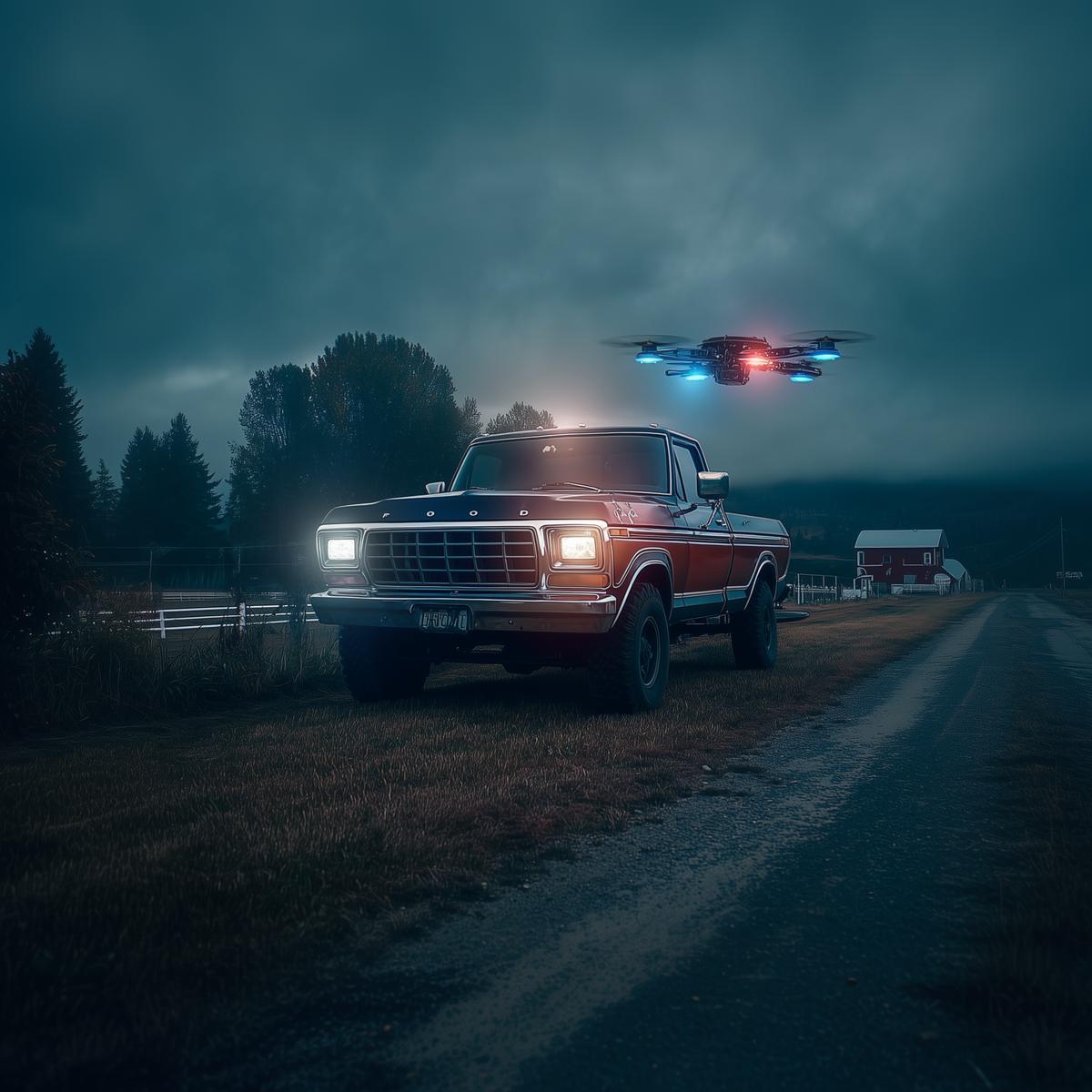
The sound pulled him hard back into the present. The sky above was empty except for two small shapes descending fast — silver drones, each the size of a suitcase, their motion precise and silent.
A voice came through the open window, smooth and toneless:
“Citizen. Please bring your vehicle to a complete stop.”
Wayne’s foot eased off the pedal. The Ford rolled to a halt beside the fence line.
He sat still, heart heavy.
The drones hovered near the hood, light beams sweeping across the windshield.
“This vehicle is operating without network synchronization,” one said. “Please remain seated while verification is attempted.”
“I’m the owner,” Wayne said quietly. “Wayne Cole. It’s my truck.”
“Please exit the vehicle.”
He hesitated. “I’m not doing anything wrong.”
“Manual operation of unregistered vehicles is a violation of the Global Mobility Accord. Please exit the vehicle.”
He sighed and reached for the glove box, meaning to show them the title — maybe they’d understand. The latch snapped open. A folded sheet of paper fell across his knee, and a photo slipped from between the folds, landing on the floorboard at his feet.
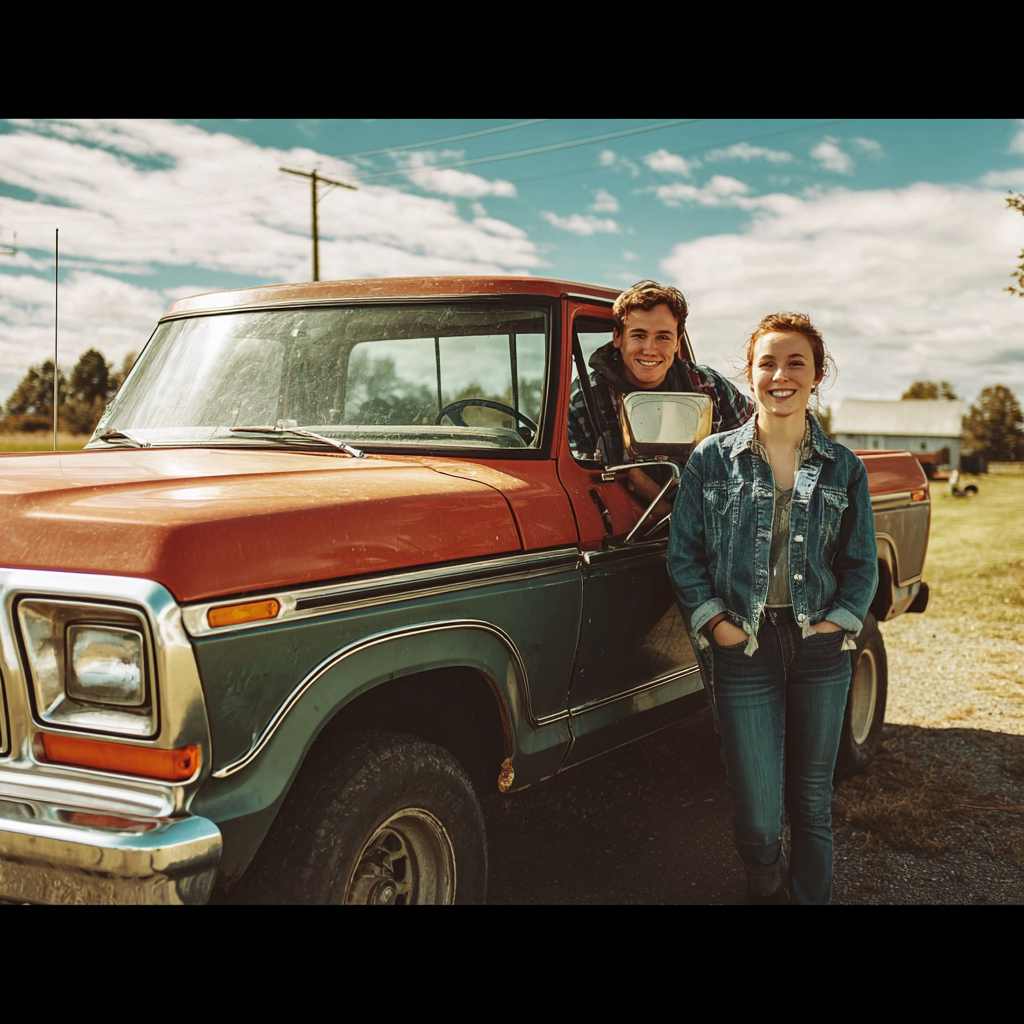
It was the one he’d always kept — him and Darla in 2027, smiling with the truck.
Before he could pick it up, a sharp electronic tone filled the cab. The dashboard lights flickered, the engine gave one last uneven cough, and then silence. The gauges fell to zero.
“Vehicle systems disabled,” said the drone. “Exit immediately.”
Wayne looked down at the photo on the floor — her smile, the sun, the way her hair had caught the wind that day.
He reached toward it, stopped halfway.
The voice repeated, firmer now:
“Exit the vehicle, Citizen.”
He drew his hand back, opened the door, and stepped out.
The air was still. The smell of hot metal and dust lingered.
Behind him, the Ford sat quietly, lights dead, engine lifeless.
Through the glass, he could still see the photo lying face-up on the mat, sunlight sliding slowly across its surface.
A deeper hum grew on the horizon. A large retrieval truck rolled into view — matte gray, windowless, uncrewed. It stopped with perfect precision behind the Ford.
Metal clamps unfolded, locking onto the frame.
“Citizen Wayne Cole,” the drone announced, “this vehicle has been scheduled for decommissioning under statute forty-seven-C. Compensation will be processed upon verification.”
“There’s no need for this,” he said, voice breaking. “She’s mine. Just let me take her home.”
“Private ownership of non-networked vehicles is prohibited. Please remain outside the hazard zone.”
He stood helplessly as the clamps tightened and lifted the truck onto the hauler’s deck. The dust swirled beneath its tires, catching the sunlight.
“You are scheduled for a compliance hearing on July 17th, 2058, at 09:00 local time. A City Transport Unit will arrive to convey you. Do you acknowledge?”
He nodded once, not trusting his voice.
“Acknowledgment recorded. Thank you for your cooperation.”
The hauler began to roll forward.
Through the rear window, Wayne saw the photo glint one last time before the sunlight vanished inside the shadow of the machine.
The road grew quiet again.
He stood there until the dust settled and the hum faded into the distance.
Then, slowly, he wiped a tear from his cheek.
The drones lifted in unison, rising like indifferent angels.
“Have a safe and compliant day, Citizen.”
They disappeared into the sky.
The road was empty again. Wayne stood in the silence, dust drifting across his boots, the air already cooling as the morning faded.
From the horizon came another sound — low and even, mechanical.
A silver transport pod glided toward him along the shoulder, whisper-quiet.
It stopped exactly two meters away, its surface seamless and clean, no windows, just a soft pulse of blue light where a face should have been.
“Citizen Wayne Cole,” the voice said, smooth and courteous. “You are authorized for return transit. Please enter the vehicle.”
The door unfolded sideways with surgical precision, revealing a white interior — sterile, polished, smelling faintly of ozone and disinfectant. There were no seats in the traditional sense, just molded surfaces that shaped themselves around whoever sat inside.
No buttons. No mirrors. No dashboard.
Only silence.
He stepped in. The door sealed behind him.
“Destination confirmed,” the voice said. “Cole Residence.”
The pod accelerated without sound, the world outside sliding past behind frosted glass.
There was no hum, no vibration, no sense of motion at all — only the faint whisper of air through the vents.
Wayne stared at the featureless walls.
No knobs to turn. No wheel. No world to touch.
The calm, modulated voice broke the silence.
“You will receive a digital notice regarding your compliance hearing within forty-eight hours. Your cooperation is appreciated.”
He said nothing.
His reflection floated faintly in the curved surface — pale, hollow-eyed, the ghost of a man who once knew what freedom felt like.
The pod turned down the narrow gravel lane toward his property and came to a gentle stop by the gate.
The door opened with a polite chime.
“Destination reached. Thank you for choosing City Transport.”
He stepped out into the sunlight. The door closed behind him without a sound, and the vehicle glided away, disappearing down the road like a thought erased.
The wind was picking up again.
The field grass bent in slow waves.
He stood by the fence, watching the empty road stretch into the distance — the same road he’d driven that morning, the same one he’d driven with Darla so many years ago.
The horizon shimmered under the sun, heat and memory blending until it was hard to tell which was which.
He took a slow breath, the air tasting like dust and silence.
His eyes softened.
“One last time, Darla,” he whispered. “One last time.”
The words drifted into the wind, carried down the empty road until they were gone.
The gate creaked as he closed it behind him.
The house waited — small, still, human — as the automated world moved on without him.
He was the last driver.
And the world would soon forget what it felt like to be one.