
Aug 15, 2025
3 min read
Why Life’s Oldest Survival Strategy Must Shape Our Future
Some dream of a perfect society built from a single, all-seeing control nexus — a benevolent intelligence optimizing every decision.
No secrets. No shadows. Perfect order.
It’s a seductive vision.
It’s also dangerous.
Privacy isn’t a quirk of human culture we can discard when technology matures.
It’s a structural element of life itself — running through history, biology, and the systems that keep reality from collapsing.
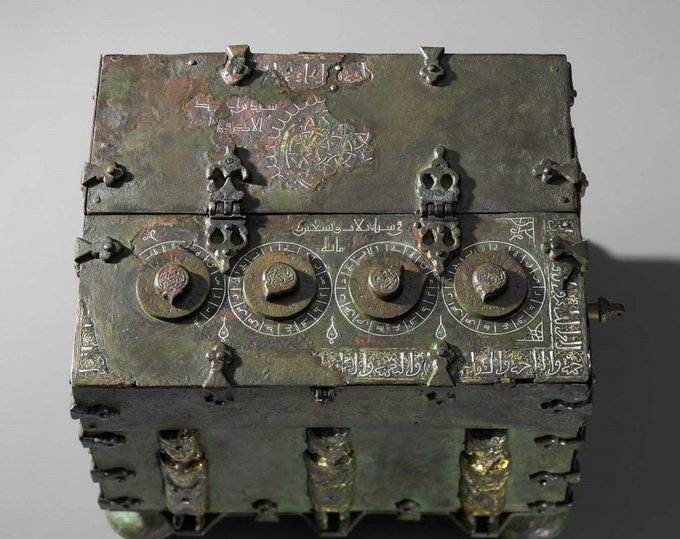
A 12th-Century Lockbox
In the Museum of Fine Arts, Boston, sits a Seljuk-era brass-and-silver lockbox from Isfahan, signed by Muhammad ibn Hamid al-Asturlabi.
“The top bears four dials… to create the eight-number code of an early ‘combination lock.’”
Its security isn’t brute force — it’s concealment. Multiple dials hold fragments of the truth. No single point contains the whole answer.
This principle is older than any artifact: distribute the risk, hide the keys, protect what matters.
Nature’s Private Channels
Viruses coordinate attacks with molecular whispers. As Nature reports, some phages “produce a six amino-acids-long communication peptide… [and] lysogenize if the concentration is sufficiently high.”
They hide their intentions until the moment is right.
Plants do the same. “Plants talk to other organisms and between themselves using volatile organic compounds (VOCs) as their alphabet,” notes one review. These scents are targeted messages, invisible to those who shouldn’t hear them.
Even our genome is mostly privacy. “Less than 2 percent of the genome codes for proteins,” according to the NIH. The rest is regulation, structure, and controlled access — nature’s encryption layer.
And at the cellular level, life is built on gated borders. Every cell has specialized pores — channels and pumps — that allow only certain molecules in or out, in a strict order, at precise times. These are the DMZs of the molecular world. They regulate traffic, filter signals, and protect the cell from chaos.
The body does not micromanage each cell. Instead, trillions of them coordinate through a symphony of chemical messages and electrical impulses — a decentralized network where privacy and selectivity are the foundation of life’s stability.
Distributed Decisions
Honeybees don’t get orders from the queen. Scouts explore, compare sites, and “send inhibitory stop signals to other scouts… causing them to cease dancing,” reports Science.
No single bee holds the full plan.
This decentralization prevents catastrophic errors. When systems rely on a single authority, failure is amplified — as in the 2003 Northeast blackout, when “a lack of situational awareness” cascaded into a massive grid collapse.
A Human Right, Not a Luxury
Edward Snowden put it plainly:
“Arguing that you don’t care about the right to privacy because you have nothing to hide is no different than saying you don’t care about free speech because you have nothing to say.”
Privacy isn’t about secrecy for secrecy’s sake.
It’s about preserving the conditions for autonomy, innovation, and survival.
The Wrong Utopia
Total visibility erases the buffers that keep complexity alive.
Centralized control flattens diversity and destroys resilience.
Life’s true blueprint is a network of guarded nodes — each free to adapt, test, and act locally.
The real purpose of privacy?
To keep the system — whether organism, society, or planet — alive enough to change.
Our Compass
At Tobiko, we believe the systems we build must reflect the same principles that have kept life thriving for billions of years:
- Decentralization to avoid single points of failure
- Selective sharing to protect diversity and creativity
- Privacy by design to ensure freedom endures
Utopia will not be built on centralized powers.
It will be built the way nature builds life — through distributed wisdom, guarded channels, and the oldest survival strategy we know.
And today, two technologies define the new boundary where this battle will be fought: artificial intelligence and cryptocurrencies.
AI will shape the systems that think for us. Cryptocurrencies and decentralized ledgers will shape the systems that move our value and record our truth.
If we do not draw strong lines here — ensuring transparency in power but privacy in the individual — we risk surrendering the natural and the real to the false idols of the Matrix, the collective assimilation of the Borg, or the cold logic of Skynet.
The choice is ours: build tools that honor life’s oldest strategy, or be absorbed by the systems that forget why life needed it in the first place.
Privacy is not optional. It is necessary.