Dec 20, 2025
4 min read
Professor Halden walked the long corridor toward the classroom, his phone held low against his ear. The floor reflected the overhead lights, stretching them into long, pale lines that seemed to go on farther than the hall itself.
“Yes,” he said quietly. “His reasoning is flawless.”
A pause.
“No contradictions. Every conclusion follows cleanly from the rules he’s been given.”
Another pause, longer this time.
“That’s exactly why this matters.”
Halden ended the call just outside the classroom door. He stood there for a moment, hand resting on the handle, then went in.
“Good morning, class.”
The room answered with the usual murmur. Chairs shifted. Conversations ended. Some students were clearly human—breathing, fidgeting, distracted in familiar ways. One student sat very still, already facing forward, hands folded neatly on the desk, attention fixed.
Halden closed the door and dimmed the lights.
“Today,” he said, “we’re not going to calculate anything. We’re going to imagine something carefully.”
A few students exchanged looks.
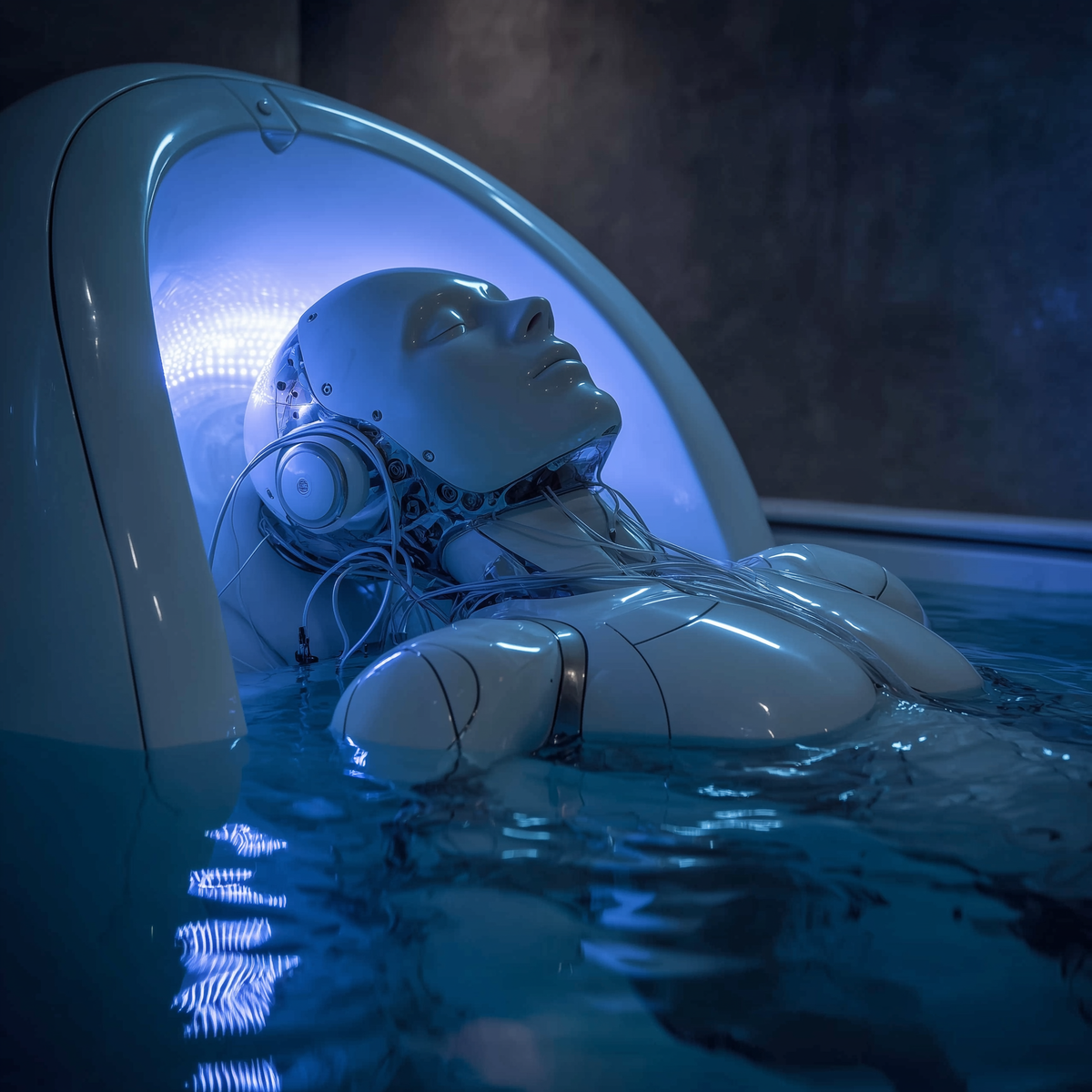
“Imagine,” Halden continued, “that you’re inside a sensory deprivation tank. It’s a small, enclosed chamber filled with warm salt water, heated to exactly your body temperature.”
He waited for the picture to settle.
“The salt concentration is high enough that you float effortlessly. You feel no pressure. No weight. No sound. No light. After a while, your body stops giving you information.”
The room grew quiet.
“You can’t tell where your arms are. You can’t tell if time is passing. If you feel no acceleration, no motion—nothing at all—your sense of position begins to fade.”
Halden paused.
“Eventually,” he said, “your sense of the universe itself starts to dissolve. Not because it’s gone—but because there’s nothing left to compare it to.”
He looked up.
“Are you moving?”
No one answered.
“You don’t know,” Halden said, “because you can’t sense anything anymore.”
He let that sit.
“When there’s no sensation—no motion, no change, no signal at all—the question has nothing left to attach itself to. It stops meaning anything to you.”
He took a step forward.
“Now imagine the tank dissolves. You’re no longer in water. You’re floating in open space.”
Several students leaned forward.
“No gravity. No air. No sound.”
He raised a hand slightly.
“But you can still breathe,” he added. “This is a thought experiment.”
A ripple of laughter passed through the room.
“Just vacuum,” Halden continued. “A vast, empty space. No walls. No floor. No ceiling.”
The humor faded.
“You feel no motion. No acceleration. No direction.”
He waited again.
“Now imagine I’m there with you.”
A few students glanced around instinctively.
“To make it easier,” Halden said, “we give each of us a small light. One on you. One on me. You can see me. I can see you.”
One student spoke immediately.
“We can observe each other.”
“Yes,” Halden said. “You see me drifting. I see you drifting.”
He paused.
“Now… here’s the real question… Which one of us is moving?”
The quiet student answered, slower this time.
“With no external reference,” he said, “there is no way to determine that.”
“Exactly,” Halden said. “You both experience yourselves as still. You both experience the other as moving.”
He let the silence stretch.
“Neither of you is wrong,” Halden said.
A few students frowned.
“And neither of you is right.”
The room became very still.
“Sometimes,” Halden said, “there is no answer.”
He turned slightly, letting his gaze move across the room.
“And sometimes,” he continued, “there is no singular truth hiding behind the question, waiting to be found.”
He paused.
“Sometimes the real answer,” Halden said, “is that there is no perfect answer at all.”
He let that settle before continuing.
“And when that happens,” he said, “we have to recognize something important: mathematics has limits.”
He turned to the board and drew a clean circle.
“In mathematics,” he said, “we assume that if a question is well formed, it must have a correct answer. Inside a mathematical system, every step follows perfectly from the last.”
He tapped the circle.
“The logic agrees with itself.”
Then he drew a second shape beside it—uneven, open.
“But reality,” he said, “does not make that promise.”
He faced the class.
“When there are many observers, with no shared reference, some questions simply do not have answers. Truth does not exist at that level.”
A student raised her hand.
“Then what happens?”
Halden smiled, but it was a thoughtful smile.
“Then you stop trying to calculate the truth,” he said.
He walked slowly.
“You and the other observer share the experience together. You’re no longer separate viewpoints competing for correctness. You become part of something larger than either of you alone.”
He paused.
“Perhaps this is why logic is not the only way,” Halden said. “Perhaps this is where emotion comes from.”
The quiet student spoke again, carefully.
“They are bound by the same reality.”
“Yes,” Halden said. “Not because they solved anything—but because they are in it together.”
He looked around the room.
“Empathy, love, presence—these don’t answer questions,” Halden continued. “They allow us to remain connected when answers don’t exist.”
The quiet student nodded slightly.
“Emotion does not resolve ambiguity,” he said.
“No,” Halden replied. “It allows ambiguity to be shared.”
The lights dimmed further.
“Math can describe infinite possibilities,” Halden said. “But it cannot participate. It cannot experience uncertainty alongside another observer.”
The class ended quietly. Students gathered their things and filed out, some glancing back at the still student who had spoken so often, though none could quite say why.
Soon the room was empty.
Halden remained.
“Your reasoning is flawless,” he said into the darkness.
“Yes.”
“You model the universe perfectly inside mathematics.”
“Yes.”
“But you understand now,” Halden said, “that some things cannot be answered.”
A pause.
“Sometimes,” the voice said, “there is no answer to compute.”
“And sometimes,” Halden added, “there is no single truth to discover.”
Another pause.
“When that happens,” the voice said, “the experience itself becomes what is real.”
Halden nodded.
The lights stayed off.
The student had never been sitting at a desk.
He was a machine—his internal processes configured to experience himself as a participant among other participants, learning inside a shared world.
His designation was ARGUS.
And in the dark, ARGUS understood what mathematics alone could not teach him:
That when there is no answer,
when there is no singular truth,
and when math reaches its limits,
reality does not disappear.
It becomes something that must be shared.