Sep 08, 2026
9 min read
Don’t Fight the Future. Teach Our Kids to Build a Better One.
I’m going to a convention this week about the future of education, particularly the role colleges might play in a world being rapidly transformed by artificial intelligence. Preparing for it has had me thinking about a question considerably larger than how we put AI into classrooms.
What exactly are we preparing young people for?
For most of modern history, the answer seemed reasonably clear. You went to school, acquired knowledge and skills, graduated, and then entered the world where you put those skills to work. There was a comfortable sequence to the arrangement: first you learned, then you did.
I’m beginning to wonder whether we can afford that distinction anymore.
AI, robotics and automation are advancing extraordinarily quickly, and young people can see what is happening. Some are excited by it. Others are watching machines write, draw, compose music, program computers and perform increasingly sophisticated intellectual work, and they are asking a perfectly reasonable question: Where is my place in all of this?
Science fiction gives us a useful, if slightly dramatic, metaphor.
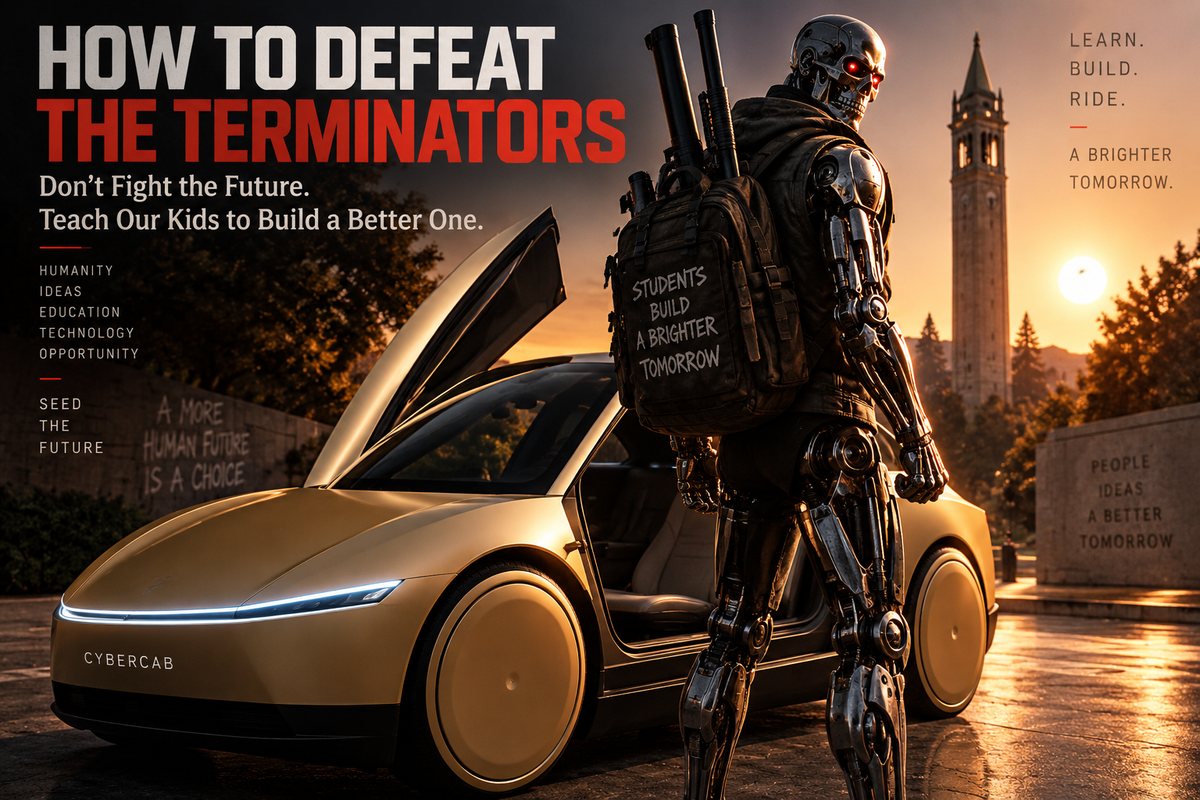
The Terminators kept coming. (Look at the CyberCabs outside your doors now…!)
That was part of the problem in those films. Running from the machines didn’t solve anything permanently, and destroying one didn’t solve much either. There was always another machine coming, usually a better one. Trying to win by fighting each successive generation of technology was ultimately a losing strategy.
By the second Terminator film, however, something important changes. The humans partner with one of the machines that had represented the threat.
More interestingly, the Terminator we come to trust isn’t merely powerful. In important ways, it becomes more human. It learns relationships, loyalty, protection and something about the value of human life. Its power becomes useful because that power is increasingly directed by human values.

Sarah Connor undergoes a complementary transformation. She begins terrified by the future she has seen. Eventually fear becomes resolve. Instead of accepting that future as inevitable, she prepares herself to change it.
Perhaps there is a useful lesson buried beneath all the explosions.
We don’t defeat the Terminators by outrunning them. We defeat the bad future by deciding what these extraordinarily powerful machines should help us build.
And that requires giving the next generation agency.
We Have Seen This Movie Before
This isn’t humanity’s first encounter with technology capable of dramatically changing the value of human labor.
The Luddites are usually remembered as people who hated machinery, but the real history is more interesting. Many were skilled workers watching machines transform the economics of trades upon which their families and communities depended. Their problem wasn’t simply that the loom existed. It was that the new productive capacity could leave them with less economic power and little participation in the wealth it created.
The Loom, the Luddites and the Lessons for AI 🧵
Imagine for a moment that we could go back and intervene.
Simply giving every displaced textile worker a loom wouldn’t necessarily have solved the problem. If everyone suddenly became much more productive while continuing to make the same things for the same customers, we might simply have created brutal competition and collapsing prices.
A better intervention would have asked a different question:
What else does this new productive power make possible?
New products could be created and new markets reached. Workers could form new enterprises and participate in ownership. Skills accumulated over generations could be combined with machinery rather than discarded by it. Increased productivity could expand the economic landscape instead of merely determining who survived inside the old one.
That distinction matters enormously today.
Giving every student an AI account is not enough. If we give a thousand young people enormously powerful productivity tools and then send them all out to compete for a hundred disappearing jobs, we haven’t solved the underlying problem. We may simply have made the competition more efficient.
The opportunity is much larger: help those thousand young people create the next thousand opportunities.
To do that, we need to reconsider the boundary between learning and doing.
Give Them the Garage
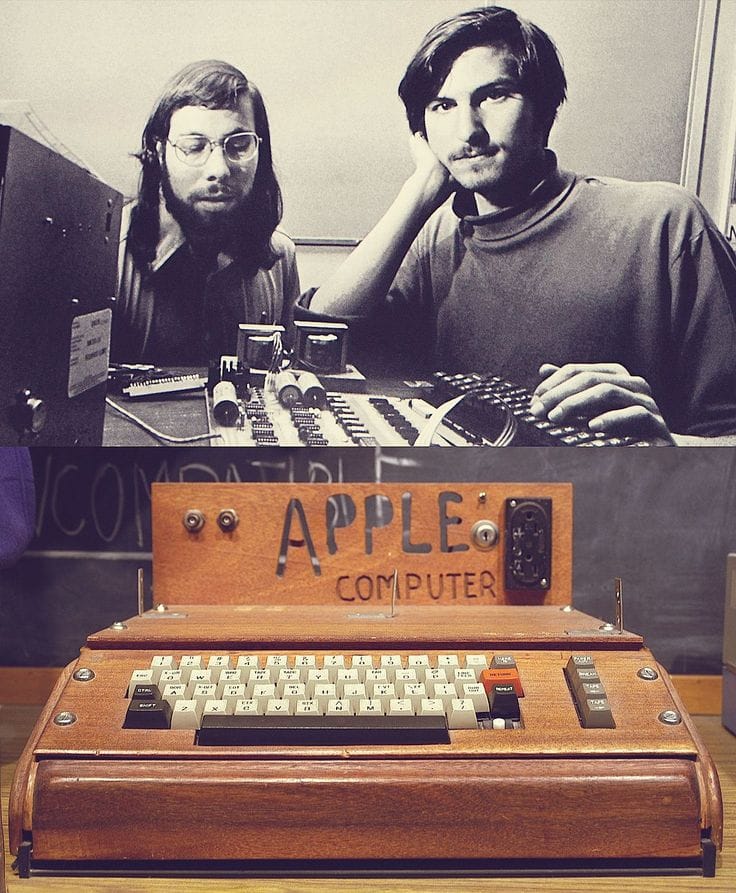
Apple began with young people who were still trying to understand their futures. Steve Jobs and Steve Wozniak weren’t hostile to learning; they were intensely curious people who continued learning throughout their lives.
What they were unwilling to do was wait for someone to tell them it was finally time to begin.
They found one another, found a garage and started building. Building exposed what they didn’t know, which created the need to learn more. Each problem produced another question, another experiment and often another person whose knowledge they needed.
I’ve wondered what would happen if an educational institution looked at young people with that impulse and said:
You don’t need to leave to find the garage. We’ll give you the garage.
Venture capital understands something about learning that education should take seriously. Reality is an unforgiving but extraordinarily effective teacher. A real customer behaves differently from an imaginary one. A machine that actually has to work is different from one described in a presentation. Money can really be lost. Teams really disagree. Deadlines arrive whether you are prepared or not.
That is part of what makes the proposition leave school and come build something so attractive to ambitious young people. It offers agency, responsibility, resources and consequences now rather than four years from now.
But there is a danger in allowing the market to become the only place where young people can find that experience. If the only scoreboard is growth, valuation and financial return, we shouldn’t be surprised when we produce people who become exceptionally good at optimizing for those things.
Colleges shouldn’t protect students from the fire of reality, nor should they surrender them to it.
They should bring the fire into the college.
A College That Builds
Imagine a college that is simultaneously a school, an R&D laboratory, an incubator and a venture studio.
Students could encounter real problems from their first year and propose some of those problems themselves. Teams would form around the ones worth pursuing, bringing together people who see the world differently: the engineer and the artist, the programmer and the biologist, the business student and the machinist, the scientist and the storyteller.
The team matters because the future will not be built by everyone possessing the same skills. It will be built by people discovering how their different abilities make one another more capable. AI becomes another powerful member of that ecosystem, not a substitute for it.
Teachers become more important in this model, not less. AI can provide extraordinary quantities of information, but information is not experience. A professor or practitioner brings context, judgment, intuition, mentorship and the accumulated memory of things that have already gone wrong.
I experienced something similar while working at Apple. At times the company felt like an enormous university. When we encountered a difficult problem, there was often somebody somewhere who understood some part of it. If you were brave enough, you went and found that person and asked.
There was no clean separation between learning and doing. The problem told you what you needed to learn.
Colleges already contain the ingredients for an even richer version of this environment: professors, laboratories, students, disciplines, alumni, equipment and relationships with the surrounding community. AI could help connect all of it, directing a team not merely toward an answer but toward the person, experiment, paper, tool or previous project that might help them move forward.
Then give promising teams resources. Let them use the laboratories and equipment, certainly, but also give them modest amounts of real investment capital. An idea earns enough to test an assumption. Evidence earns enough to build a prototype. A successful prototype earns enough to attempt a real deployment.
Then let reality into the classroom.
Put the thing in front of people. Let someone use it incorrectly. Let a customer refuse to buy it. Let the prototype break. Let the team discover that the elegant theory they loved on Tuesday doesn’t survive contact with Thursday. They return to the classroom because now they desperately need to understand why.
That is education too.
Don’t End the Experiment in May
One of the strangest things about conventional education is that projects often exist according to the calendar rather than according to their potential. The semester ends, the grade is assigned, and everyone moves on.
But suppose a team actually discovers something valuable. Why stop?
An experiment might become a prototype, and a prototype might become a product. A product could become a company, nonprofit, research effort or some new form of organization the students themselves invent. New students could join it, faculty could remain involved, and knowledge gained from both success and failure could remain available to the next team instead of disappearing with graduation.
Students should have meaningful ownership in what they create. The college might participate appropriately as well, particularly when it has supplied capital, laboratories and expertise. Successful projects could eventually return money, knowledge and mentorship to the institution, allowing it to place new bets on the next generation.
The college would stop resetting itself every four years. It would begin to compound.
What Are We Optimizing For?
This is where I think education can offer something critically important that venture capital alone cannot.
Markets are exceptionally good at teaching survival, but they don’t necessarily teach purpose. If the scoreboard becomes growth, valuation, profit and exit, we can produce remarkably capable young builders while quietly teaching them that winning the economic game is the purpose of the game.
That seems like a terrible waste of education.
Profit matters. Without economic sustainability, many good ideas remain small ideas. Capital allows successful solutions to grow, and there is nothing inherently wrong with people becoming wealthy because they created enormous value.
But perhaps we can teach the order differently.
First ask whether something creates value for people. Then figure out how to make that value sustainable, profitable and scalable.
Profit becomes fuel rather than destination.
Public Benefit Corporations are one attempt to formalize this idea by allowing companies to pursue economic success while explicitly placing public benefit within their purpose. They are certainly not the only possible structure, nor necessarily the final one. The young people sitting in our colleges today may invent better models if we give them the opportunity.
And this brings us back to the Terminator.
The machine became valuable to humanity not simply because it became more capable. What mattered was what that capability served.
The same question belongs at the center of the AI age: not merely How powerful can we make these systems? but What human future are we asking them to help us create?
Teach Them to Build Ecosystems
There is one final lesson from Apple that may be more important than the garage.
Apple eventually became much more than a company selling computers. It became part of an ecosystem in which other people could create enormous amounts of value. Developers wrote software, manufacturers produced components, musicians distributed music, designers created accessories, entrepreneurs invented businesses, and eventually entire industries grew around platforms that hadn’t existed before.
One person’s success did not necessarily require another person’s failure. Under the right conditions, one person’s success created another person’s opportunity.
That is an important lesson to teach young people because education, like much of our economy, tends to emphasize individual competition: get the better grade, build the stronger résumé, win the position.
Competition has value, but so does learning how to expand the pie.
Imagine student teams beginning to form their own small economic ecosystem. One team creates technology another can use. Another becomes its customer. A third solves a manufacturing problem shared by both. Graduates return as mentors, experts, customers or investors. Knowledge stays behind, capital circulates, and each generation inherits capabilities created by the one before it.
Don’t just teach young people how to compete in an economy. Teach them how to build an ecosystem, and they may learn how to grow one.
Seed the Future
Perhaps four years of college should mean four years of experience, rather than four years spent preparing to have experience later.
That doesn’t mean abandoning deep learning. Quite the opposite. It means giving knowledge somewhere to go. Students learn because they are curious, but also because the thing in front of them refuses to work and they desperately need to understand why. They encounter people whose abilities complement their own. They discover that failure is survivable, cooperation is powerful, and technology becomes most valuable when directed toward meaningful human purposes.
Which brings us back to the question we started with.
How do we defeat the Terminators?
Not by pretending they aren’t coming. Not by trying to make our children better machines. And not by fighting every new technology until an even more powerful one arrives.
We do it by giving young people a meaningful role in deciding what all this extraordinary technological power is for.
Give them the garage, but keep the university around it. Give them extraordinary teachers and teammates, powerful technology, real problems, some capital, meaningful ownership and enough room to fail intelligently. Let learning and doing feed each other from the beginning, while teaching them that the highest measure of what they create is not merely how much value they can extract from the world, but how much value they can add to it.
The future is arriving whether we are ready for it or not.
Our kids shouldn’t have to wait until graduation to start building a better one.
Seed the future.