Sep 06, 2026
4 min read
When I was a student in my first digital logic class, I learned binary.
On or off. 1 or 0. Yes or no.
It was wonderfully simple. With two states you could construct logic, and with enough logic you could construct a computer.
But I remember thinking that the world didn't seem to work that way. There was an in-between. There were things that were uncertain. There were questions for which the answer was simply:
UNKNOWN. Not sure yet.
I asked whether there was anything in digital logic that had three states. I was told about tri-state logic.
I found that fascinating. Why don't we use this?
But as I continued studying computers, I hardly heard about it again. It seemed to be a strange footnote. Everything returned to 0 and 1.
I didn't forget about it.
At the same time, I kept learning about physics. I read about Einstein and his ideas over and over, trying to understand what relativity was really saying.
Eventually something began to click.
Measurements of space and time could depend upon the observer's frame of reference. There wasn't one privileged observer sitting at the center of the universe with the absolute point of view.
And that led me to another thought:
EVERY OBSERVER MATTERS.
My point of view isn't the anchor of reality. Neither is yours. We can observe the same world from different positions and have different descriptions of what we see. That doesn't mean there is no truth, or that every conclusion is equally correct. It means we cannot simply assume that our own point of view is the definitive one.
We share observations.
We compare them, find what remains consistent between them, and from those different points of view build a better understanding of the reality we share.
Then quantum mechanics made this considerably stranger.
I learned about light, waves and particles. I learned about experiments in which a quantum system could be described through a range of possible outcomes, while measurement produced something definite.
There was that word again: observer. Or, more accurately, measurement.
Whatever the ultimate interpretation, something interesting happened at that boundary. Before measurement there were quantum possibilities. After measurement there was a result.
The unknown had become known.
Then came quantum computing.
When I began learning about qubits, I thought again about that digital logic class. Here, finally, was computation that wasn't confined to manipulating ordinary bits that were always simply 0 or 1. A qubit could exist in superposition, and quantum computation could make use of that state before measurement.
It was far more interesting than the third state I had wondered about as a student.
And then another thought occurred to me.
A quantum computer isn't merely a conventional computer simulating quantum mechanics. The qubits are physical quantum systems.
We prepare them, manipulate them, allow them to interfere, and then measure them.
In a rather literal sense:
WE ARE ASKING THE UNIVERSE A QUESTION.
And the universe replies.
For certain kinds of problems, we can formulate the question so that the quantum behavior of nature itself becomes part of the computation. We interact with the quantum system and eventually measure it, producing information we can read.
We are beginning to solve extraordinarily difficult problems by learning how to compute with something I had wondered about since that first digital logic class:
the not-yet-known.
Then I read Carlo Rovelli's White Holes.
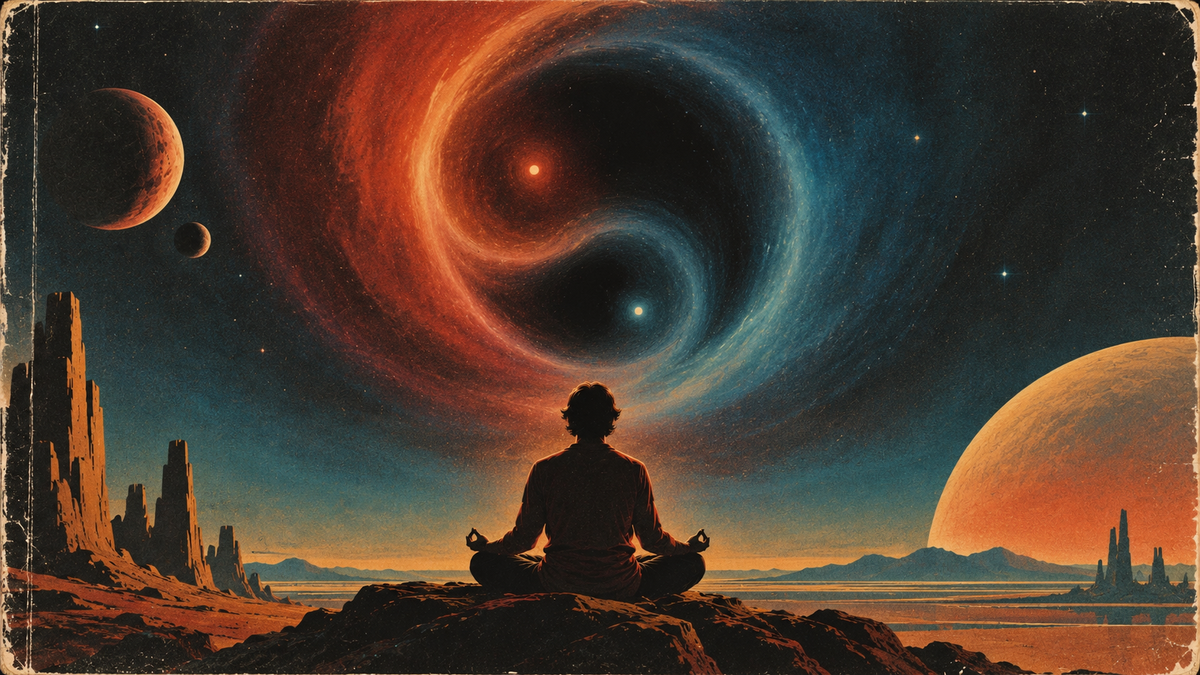
Rovelli explores the possibility that a black hole may eventually transition into a white hole. As I tried to picture what he was describing, I kept seeing a symbol I had encountered while studying ancient philosophy:
Yin and Yang.
Inward and outward. Black and white. One becoming the other. I began imagining the black hole and white hole almost as a rotating, recursive Yin and Yang—a continuing flow from one state into another.
I wasn't suggesting that ancient philosophers understood black-hole physics. What interested me was the recurrence of the pattern.
For centuries we have placed science and philosophy in different rooms. Science dealt with what could be measured. Questions about existence, consciousness and meaning usually went somewhere else.
Yet the rooms seemed to be getting closer.
Then there was Roger Penrose.
Penrose helped establish the modern mathematical understanding of black holes. He is one of the people who changed our understanding of what general relativity says happens to matter and spacetime under extreme gravitational collapse.
And yet this same mathematician and physicist became deeply interested in something we still struggle to explain: consciousness.
Penrose questioned whether ordinary computation alone was sufficient to explain the human mind. With Stuart Hameroff, he developed the controversial Orch-OR theory, exploring whether quantum processes associated with microtubules inside neurons might play a role in consciousness.
It remains disputed and unproven. But the question fascinated me.
I had traveled from computers to relativity, quantum mechanics and quantum computation, then through black holes and white holes—and somehow arrived back at the observer.
What is consciousness, and what exactly is its relationship to the physical universe it observes? Could conscious observers interact with the quantum world in ways we don't yet understand?
The answer, for now, remains:
UNKNOWN.
But there is something about consciousness we don't need a new theory of physics to demonstrate. A conscious person can imagine a future that doesn't exist and begin working toward it. When other people can see that same future, believe in each other and organize around it, the probability of that future changes.
This isn't merely philosophical. Collective focus changes decisions, directs resources, creates technologies and moves matter. A spacecraft begins as something imagined by conscious minds; eventually equations are written, factories are built, metal is shaped and something that once existed only as a possibility leaves the Earth.
The imagined future becomes physical reality.
This brings me back to the observer—not one observer, but all of us. We share observations, ideas and possibilities, and through our collective focus and actions we influence what comes next.
Perhaps someday we'll discover that consciousness has an even deeper relationship with quantum reality. I suspect there is more there. But we don't need that answer to recognize something we already know:
We are creating the future.
The future is still unknown. We can imagine what we want it to become, find others who share that vision, believe in each other, and build toward it together.
Perhaps the real awakening is simply realizing that we have been doing this all along.